




Losing confidence in your balance can change the way you move through everyday life. A simple trip to the mailbox, a walk through the grocery store, or even moving around the house may start to feel less certain when stability becomes a concern. Over time, that hesitation can start to limit independence and make it harder to stay active.
Fortunately, the right mobility aid can help restore confidence. A quad cane, sometimes called a four prong walking cane, provides a wider, more stable base than a traditional single-tip cane, helping users feel more secure with every step. If you're searching for the best walking cane for balance or just need extra support during daily activities, choosing the right option can make a meaningful difference.
We'll compare some of the best quad canes available today, focusing on the two factors that matter most: stability and durability. You'll also learn which features to prioritize and how to choose the right model for your specific mobility needs.
What to Look for in a Quad Cane
Finding the right quad cane isn't as simple as choosing the first model you see online. Different users have different balance challenges, mobility goals, and living environments. A cane that works well for someone who primarily walks indoors may not be the best choice for someone who frequently navigates uneven sidewalks, curbs, or stairs.

One of the most important considerations is the size of the base. A quad cane large base design provides the highest level of stability because the four points of contact create a wider support footprint. This makes it a popular option for users who need maximum confidence while walking. In contrast, a quad cane small base is generally easier to maneuver in tight spaces and can feel more natural when climbing stairs or moving through narrow hallways. Neither option is universally better; the right choice depends on where and how the cane will be used.
Handle design also plays a significant role in comfort and safety. Many quad walking canes feature offset handles that help center the user's weight directly over the base, improving stability and reducing strain. Ergonomic or foam-padded grips can be particularly helpful for individuals with arthritis, hand weakness, or reduced grip strength, making the cane more comfortable to use throughout the day.
Material quality should never be overlooked. Most modern four point cane designs are made from lightweight anodized aluminum, which offers an excellent balance of durability and portability. While a lighter cane is easier to lift and position, it's equally important to verify the manufacturer's weight capacity to ensure the cane can safely support the intended user.
Finally, pay close attention to height adjustment. An adjustable quad cane should allow users to fine-tune the fit so their arm maintains a slight bend while standing upright. Proper height promotes better posture and can help reduce unnecessary stress on the back, shoulders, and wrists. Models with secure locking mechanisms and anti-rattle technology also provide a quieter, more stable experience, preventing the distracting movement and noise that can develop in poorly constructed mobility aids over time.
The Top 8 Quad Canes for Stability
Pelegon’s Quad Cane with 4 Prong Base
The Pelegon quad cane is designed for users who need more support than a traditional cane but don't want the bulk of a walker. Its reinforced aluminum frame supports up to 300 lbs while weighing just 2.1 lbs, making it one of the lighter heavy-duty options available. The self-standing four prong cane base provides dependable stability on a variety of indoor and outdoor surfaces, while the ergonomic grip helps reduce hand and wrist fatigue during extended use.
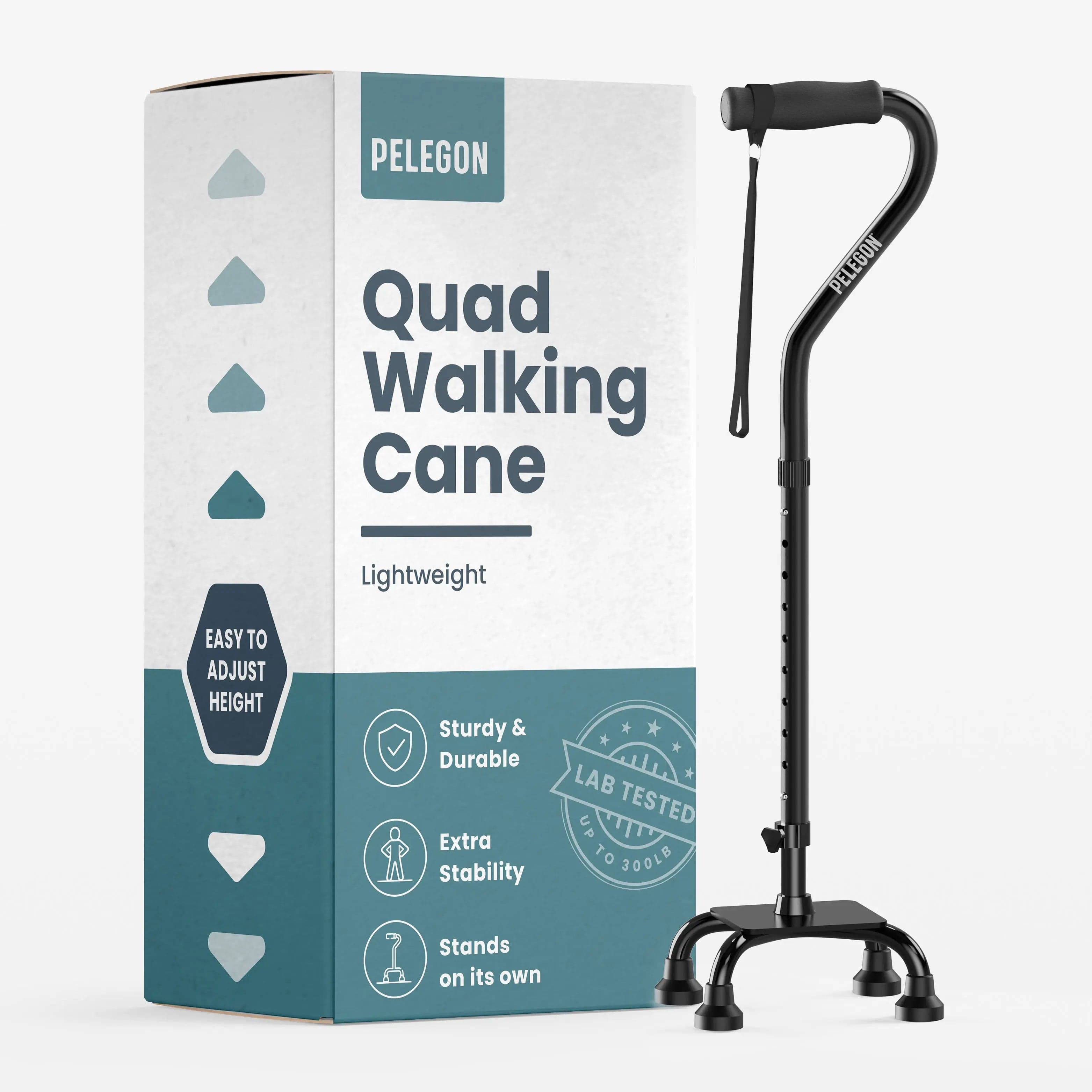
Height adjusts from 35.9" to 39.4" using a simple push-button mechanism, allowing users to find a comfortable fit that promotes better posture. Four anti-slip rubber tips improve traction on tile, carpet, and uneven sidewalks, while the self-standing design means the cane remains upright when not in use. The wider base provides extra stability, though users moving through very tight spaces may find a more compact design easier to maneuver.
Pro: Lightweight design with a 300 lb weight capacity and self-standing base.
Con: Wider footprint may feel less maneuverable in very tight spaces.
Ideal For: Everyday balance support, post-surgery recovery, and indoor/outdoor use.
Not Ideal For: Users requiring support above 300 lbs.
Pelegon’s Quad Cane with Extra Handle
The Pelegon Quad Cane with Extra Handle is designed for users who need support not only while walking, but also when transitioning from sitting to standing. Its standout feature is the integrated lower assist handle, which provides additional leverage when getting up from a couch, chair, or toilet. The reinforced aluminum frame supports up to 300 lbs, while the self-standing four-point base offers dependable stability and remains upright when not in use.

For many users, the extra handle can be just as valuable as the cane itself, reducing the effort required to stand and helping maintain confidence during everyday movements. Both grips are padded for comfort, and the adjustable height range accommodates a variety of users. While the dual-handle design adds a bit more bulk than a standard cane, it's a worthwhile tradeoff for those who frequently need assistance getting in and out of a seated position.
Pro: Integrated assist handle makes sitting and standing significantly easier.
Con: Slightly bulkier than a traditional quad cane.
Ideal For: Users who struggle getting up from chairs, couches, or toilets.
Not Ideal For: Those looking for the lightest possible mobility aid.
Vive Health’s Quad Cane
The Vive Health Quad Cane is a straightforward option for users seeking dependable everyday support at a relatively lightweight weight. Its anodized aluminum frame supports up to 250 lbs and features a reversible four-prong base that can be configured for either left- or right-handed use. The ergonomic handle is designed to reduce hand fatigue, while the non-slip rubber tips provide traction on surfaces ranging from hardwood floors to gravel paths.

Height adjusts from 28" to 37" using a brass locking pin and an additional locking screw for extra security. The reversible base is a useful feature for accommodating different users, though the lower weight capacity may not offer the same level of reassurance as some heavier-duty models. It's a practical choice for general daily use, particularly for individuals who prioritize simplicity and ease of adjustment.
Pro: Reversible base accommodates both left- and right-handed users.
Con: 250 lb weight capacity is lower than some competing models.
Ideal For: General daily mobility assistance.
Not Ideal For: Users seeking heavy-duty support.
Medline’s Offset Handle Bariatric Quad Cane
For users who require heavy-duty support, the Medline Offset Handle Bariatric Quad Cane stands out with an impressive 500 lb weight capacity. Available in both small and large base configurations, this adjustable quad cane is built with a durable steel frame, a double-plated base, and a dual-tubing insert designed to increase strength and stability. The offset handle features a foam covering to improve comfort and provide a more secure grip during daily use.

Height adjusts from 29" to 38", allowing users to customize the fit for better posture and support. The availability of both base sizes is a practical advantage, especially for those choosing between maneuverability and maximum stability. The tradeoff is that the reinforced steel construction adds noticeable weight, making it less suitable for users who prioritize a lighter, easier-to-lift mobility aid.
Pro: Heavy-duty construction supports up to 500 lbs.
Con: Steel frame adds noticeable weight.
Ideal For: Bariatric users and those requiring maximum support.
Not Ideal For: Users who prioritize lightweight portability.
Vive Health's SureWalk Quad Cane
The SureWalk Quad Cane combines a lightweight aluminum frame with a self-standing four-prong base, making it a convenient option for users who want added stability without a bulky design. Supporting up to 250 lbs, it features a height-adjustable shaft ranging from 30" to 39", accommodating a broad range of user heights. The self-standing design can be especially useful for those who prefer not to lean their cane against furniture or walls throughout the day.
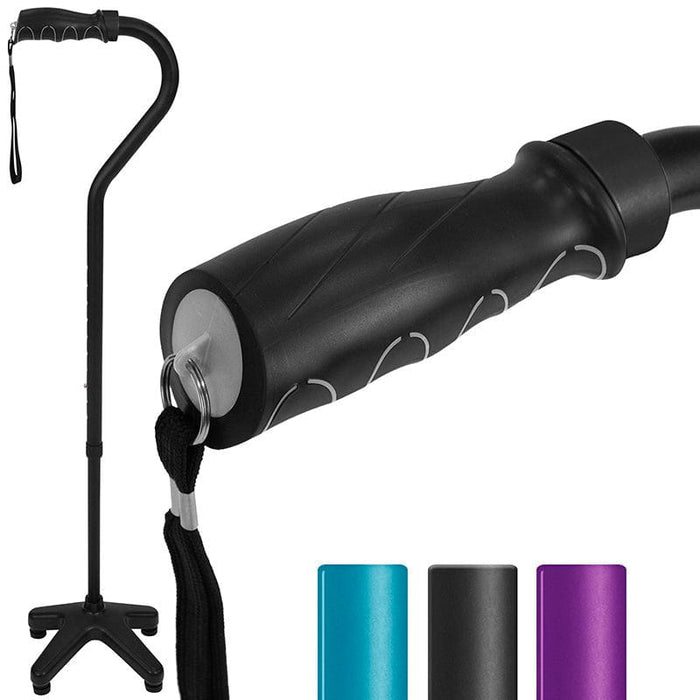
One of its most distinctive features is the patented ergonomic handle, which includes finger contours and an adjustable grip angle for a more customized fit. This may help reduce wrist strain for users who spend extended periods relying on a cane for support. However, while the plastic base helps keep overall weight down, some users may prefer the added reassurance of a heavier-duty frame and higher weight capacity when maximum stability is the priority.
Pro: Adjustable ergonomic grip can help reduce wrist fatigue.
Con: Plastic base may feel less robust than heavier-duty alternatives.
Ideal For: Users who prioritize hand comfort.
Not Ideal For: Those seeking maximum weight-bearing capacity.
McKesson Large Base Steel Quad Cane
For users who prioritize maximum stability, the McKesson Large Base Steel Quad Cane is worth considering. This wide base quad cane pairs an aluminum shaft with a sturdy steel base, creating a solid feel that can be particularly reassuring for those with significant balance concerns. The self-standing design adds convenience, while the offset handle helps distribute weight more evenly over the base for improved support.

The cane adjusts from 29" to 37.5" and features a contoured vinyl grip designed for extended comfort. Durable rubber tips with metal washer inserts help improve longevity and reduce wear over time. The tradeoff for its stability-focused design is that the steel base makes it heavier than some aluminum-only alternatives, which may be less appealing for users who frequently lift or transport their mobility aid.
Pro: Extra-wide steel base delivers exceptional stability.
Con: Heavier construction can be less convenient to lift and transport.
Ideal For: Users with significant balance concerns.
Not Ideal For: Frequent travelers or those preferring lightweight canes.
Airgo’s Comfort-Plus Adjustable Quad Cane
The Airgo Comfort-Plus is designed with comfort in mind, making it a strong option for users who experience hand pain or arthritis. Its ergonomic cushion-top handle helps absorb shock and reduce pressure on the hand, while the anodized aluminum frame keeps the cane lightweight and easy to manage. The rotating K-shaped base can be configured for either left- or right-handed use and is available in both small and large sizes to accommodate different stability needs.

One of the standout features is its impressive range of 11 height settings, allowing for a highly customized fit for users from approximately 5' to 6'5". A reflective patch on the wrist strap adds extra visibility in low-light conditions, and the cane stands on its own when not in use. While it offers excellent comfort and adjustability, users looking for a heavier-duty four point cane may prefer a model with a clearly stated higher weight capacity.
Pro: Cushion-top handle is particularly comfortable for arthritis sufferers.
Con: Manufacturer does not emphasize a higher-capacity weight rating.
Ideal For: Users prioritizing comfort and adjustability.
Not Ideal For: Those seeking bariatric-level support.
Medline’s Aluminum Quad Cane
The Medline Aluminum Quad Cane is a versatile option that allows users to choose between a small or large base depending on their mobility needs. Those looking for a quad cane small base may appreciate the added maneuverability, while users who prioritize security may prefer the larger footprint for extra support. The aluminum frame supports up to 300 lbs and features a contoured foam grip designed to improve comfort during daily use.

Four non-skid rubber tips help maintain traction on a variety of surfaces, and the self-standing design makes the cane convenient to keep within reach. The offset handle promotes more efficient weight distribution, which can contribute to a steadier walking experience. While the customizable base options are a clear advantage, users must decide upfront which configuration best suits their lifestyle and walking environment.
Pro: Available in both small and large base configurations.
Con: Choosing the wrong base size can limit its effectiveness.
Ideal For: Users who want flexibility in selecting stability levels.
Not Ideal For: Shoppers who prefer a single all-purpose design.
Finding the Right Quad Cane for Your Needs
Choosing the right quad cane comes down to finding the balance between stability and practicality. Some users may benefit from a larger base that provides maximum support, while others may prefer a more compact design that's easier to navigate through stairs, narrow hallways, and crowded spaces. The best choice is the one that fits both your mobility needs and the environment you move through every day.

A four prong walking cane can be an effective tool for improving balance, reducing fall risk, and helping older adults maintain independence while aging in place. To keep your cane performing safely, inspect the rubber tips regularly and replace them as soon as they show signs of wear. It's also a good idea to consult a physical or occupational therapist to confirm the correct cane height and learn proper walking techniques. With the right support and fit, a quad cane can help you move through daily life with greater confidence, comfort, and independence.
Frequently Asked Questions
Can you use a quad cane if you have a wrist injury or arthritis?
Yes. Many quad canes feature ergonomic or padded handles that help reduce pressure on the hands and wrists while providing additional stability.
How to walk with a quad cane for balance?
Move the cane forward first, then step forward with your weaker leg, followed by your stronger leg. This pattern helps maintain stability and evenly distribute weight.
Which side do I use a quad cane on?
Use the cane on your stronger side. This allows the cane to support your weaker or injured leg while improving overall balance.
Are quad canes safe to use on stairs?
Yes, but they require proper technique and extra caution. Many users find a small-base quad cane easier to maneuver on stairs than a larger base model.
What is the correct height for a quad cane?
The top of the handle should align with the crease of your wrist when your arm is relaxed at your side. This position allows for a slight bend in the elbow while walking.
How do I measure the correct height for a quad cane?
Stand upright in your regular walking shoes and measure from the floor to the crease of your wrist. Adjust the cane until the handle matches that measurement.
What is the most comfortable walking cane handle?
An ergonomic offset handle is often considered the most comfortable because it distributes weight more evenly and helps reduce hand fatigue during extended use.


I am looking for a sturdy 4 prong cane for my mother, she 4"11 in height and 125 pounds, so the cane needs to be adjustable in height.
Nerissa Espiritu on
My PCP prescribed a QUAD Cane for my balance.
Do you accept United Healthcare Medical Advantage plan to pay for my Cane ?
Romulo Briones on